If you're a US-based traveler, you'll often need photos for more than one document: a US passport renewal, a visa for the country you're visiting, maybe a UK ETA or India eVisa on top. Drugstore counters default to US 2×2. That's correct for a US passport — and wrong for a 35×45 mm Schengen upload without reformatting.
This guide separates the cases that share a format from the ones that don't, explains why head-size and background rules trip people up, and shows how to get every output from one session without paying retail twice.
The Exception Most Guides Skip: US Passport ≈ US Visa
Before comparing "passport vs visa" in general, know this: if you're American applying for a US visa, the State Department uses the same photo standard as a US passport.
For DS-160 (and most nonimmigrant visa) uploads, the digital file must be:
- Square JPEG, 600×600 to 1200×1200 pixels, ≤ 240 KB
- Head height 50–69% of the image (1–1⅜ inches in print terms)
- Plain white or off-white background, taken within 6 months
That's the same framing as a US passport photo. If your consulate asks for a printed copy at the interview, it's 2×2 inches — again, identical to passport print specs.
Sources: State Dept — Visa Photo Requirements, Digital Image Requirements.
Quick Comparison: Three Common Formats
| US Passport | US Visa (DS-160) | Typical Foreign Visa (ICAO / Schengen) | |
|---|---|---|---|
| Print size | 2×2 in (51×51 mm) square | 2×2 in (51×51 mm) square | 35×45 mm rectangle |
| Head height in frame | 1–1⅜ in (50–69% of image) | Same as passport | ~70–80% of image height |
| Background | Plain white or off-white | Plain white or off-white | Plain light-colored; France often requires light grey/blue |
| Expression | Neutral; natural smile OK | Neutral | Neutral, mouth closed, no smile |
| Glasses | Not allowed | Not allowed | Usually not allowed |
| Digital upload | Online renewal: JPG/HEIF, 54 KB–10 MB, system crops for you | JPEG, 600–1200 px square, ≤ 240 KB | Portal-specific (pixels, KB cap, sometimes separate passport scan) |
| Recency | Within 6 months | Within 6 months | Usually within 6 months; check each embassy |
Other sizes you'll hit from the US: Canada passport 50×70 mm (with photographer stamp on print), China visa 33×48 mm, Vietnam e-visa 40×60 mm, UK 35×45 mm with cream/light grey background preference.
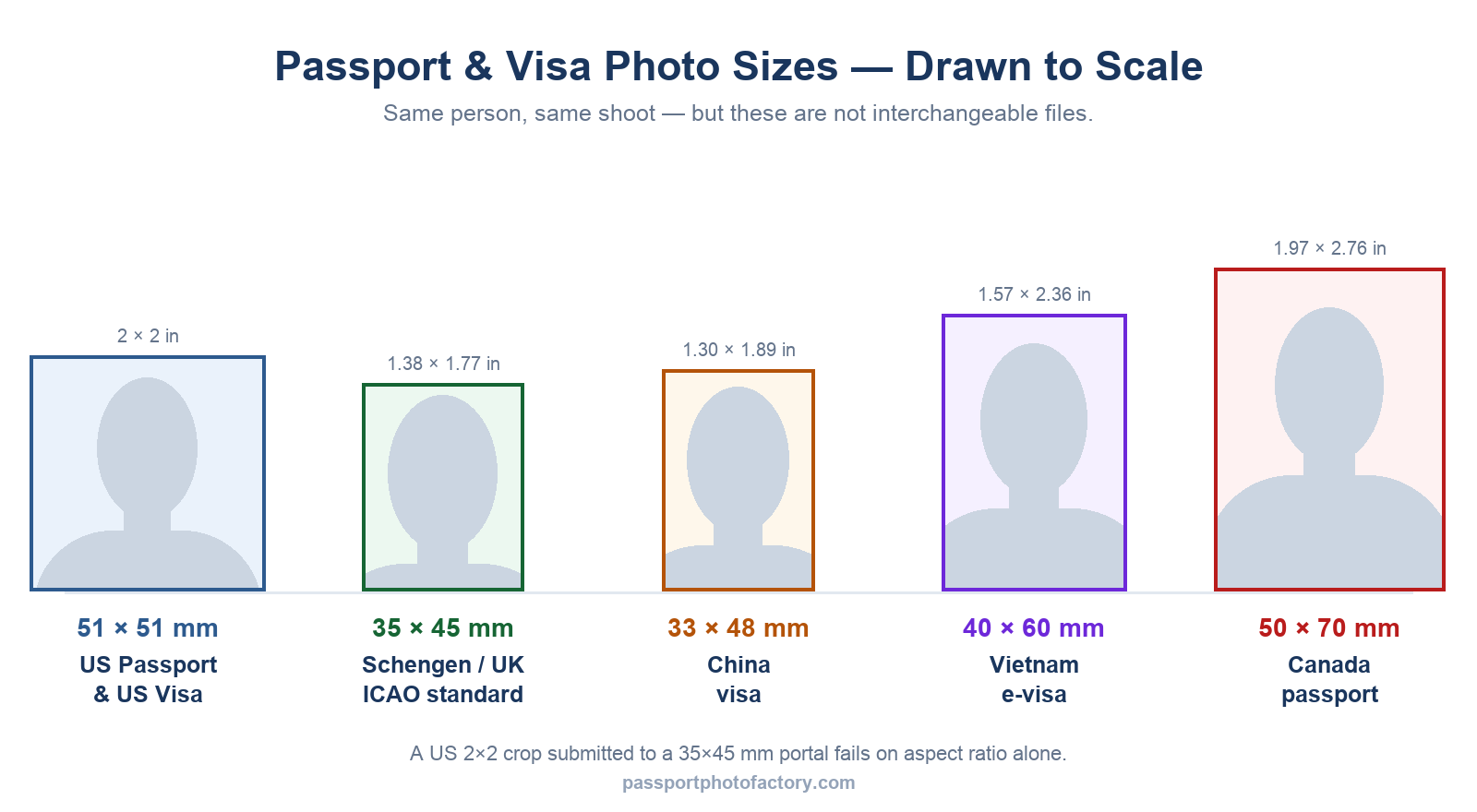
Seeing them at one scale makes the problem obvious: only the US format is square. Every other frame here is portrait, so a 2×2 crop can't be stretched or padded into it without breaking the aspect ratio a portal checks first.
When One Photo Works for Both
A single high-resolution shot can often produce multiple formatted outputs — as long as head position and expression work for the stricter spec.
-
Same format — often one crop/file:
- US passport + US visa (DS-160) — same 2×2 square; watch the DS-160 240 KB file-size ceiling
- US passport + Indian passport renewal (VFS in the US) — India specifies 51×51 mm (2×2) for printed passport photos at US missions
- US passport + India eVisa / regular visa upload — both use a square JPEG, but India enforces tighter file windows (eVisa 10 KB–1 MB, regular visa 10–300 KB) and bans spectacles on eVisa; see our India guide Same shoot, different crop required:
- US passport + Schengen visa (35×45 mm, tighter face fill, no smile) — Schengen requirements
- US passport + UK passport or ETA (35×45 mm; HM Passport Office prefers cream or light grey, not pure US white) — UK guide
- US passport + China visa (33×48 mm portrait; digital upload has its own pixel/KB window) — China guide
- US passport + Vietnam e-visa (40×60 mm / 4×6 cm applicant photo plus a separate passport data-page scan) — Vietnam guide
The failure mode isn't taking one photo — it's uploading a 2×2 file to a portal that expects 35×45 mm (or vice versa). Wrong aspect ratio fails automated checks before a human sees it.
Why Size Isn't the Only Difference
Head size and framing
US rules place the head at 1 to 1⅜ inches within a 2×2 frame (roughly 50–69% of image height). ICAO-style biometric photos — Schengen, UK, much of Europe — want the face to fill 70–80% of a 35×45 mm image. That's a visibly tighter crop.
A photo that passes US head-size limits often looks "too small" for Schengen. A visa-tight crop may violate US maximum head size if squeezed into 2×2 without re-framing from the original.
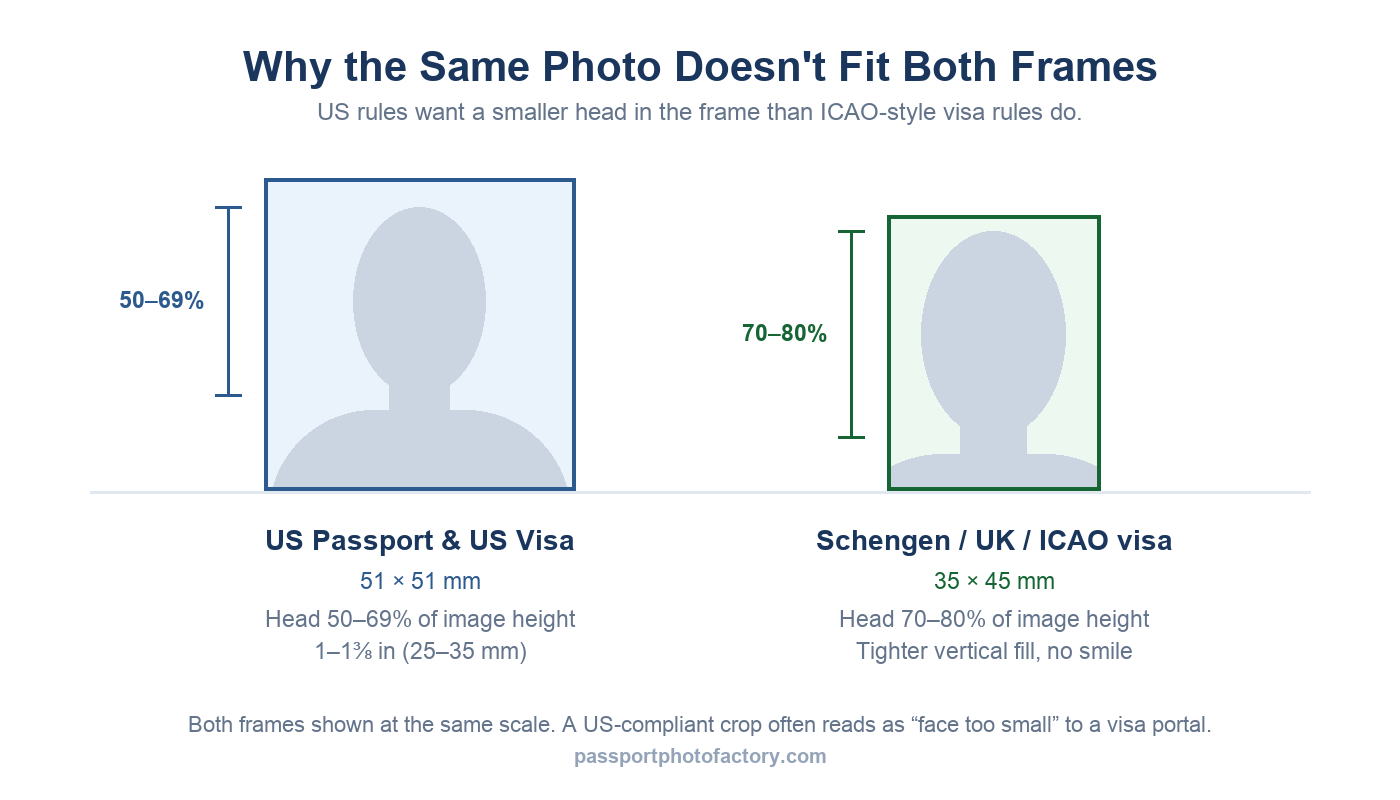
This is why re-cropping matters more than resizing. Both frames above show the same person at the same scale — the ICAO frame simply demands more of the vertical space be face. Shoot with a bit of headroom and shoulder in the original file and you'll have enough image to satisfy either rule.
Digital delivery ≠ one spec fits all
Even when print dimensions match, upload rules diverge:
| Channel | What trips people up |
|---|---|
| US online renewal | 54 KB–10 MB, HEIF OK; you crop inside the portal — not the same as DS-160's 240 KB cap |
| DS-160 visa | Must compress to ≤ 240 KB while staying 600–1200 px square |
| India eVisa | Square JPEG, 10 KB–1 MB, no spectacles, separate passport bio-page upload |
| China visa portal | 33×48 mm, JPEG roughly 40–120 KB with specific pixel bounds |
| Vietnam e-visa | 40×60 mm photo and a separate data-page image — reusing one file for both is a common rejection |
Background and expression nuance
Broadly similar rules hide important exceptions:
- UK: HM Passport Office recommends light grey or cream for prints; pure white (the US default) can cause issues. No smile, mouth closed — stricter than US passport rules.
- Schengen / EU: Light-colored background; France often rejects pure white (light grey/blue required for French passport/ID). No smile under ICAO guidance.
- Philippines: Consulate capture sites may use a blue backdrop — not something you bring from a US white-wall shoot.
- Japan / South Korea: Ears visible, minimal retouching — see Japan and South Korea guides.
- Canada: Passport photos are 50×70 mm with a professional photographer stamp on the back — a different workflow from both US 2×2 and standard 35×45 mm visas.
Real-World Scenarios (US Travelers)
Scenario 1: US passport renewal + Schengen vacation
You need:
1. 2×2 for US passport (print and/or digital per channel)
2. 35×45 mm for Schengen visa — neutral expression, no smile
→ One photo session, two formatted outputs. Submitting the 2×2 to the visa portal will fail.
Scenario 2: US passport + DS-160 visa for a relative visiting the US
Both documents use 2×2 / 50–69% head height. One crop usually works; export a ≤ 240 KB JPEG for DS-160 and a larger file (or HEIF) for online passport renewal if needed.
Scenario 3: US citizen applying for an India tourist eVisa
India's eVisa wants a square JPEG (10 KB–1 MB), not 35×45 mm. Framing resembles US 2×2, but spectacles are banned on eVisa and file-size caps differ. Indian passport renewal at a US mission uses printed 2×2 per VFS checklists. OCI and PAN card have their own sizes — our India page breaks down each form.
Scenario 4: Family trip — passports for everyone + one country's visa
Each person needs their own photo for each document. Kids and babies follow age-specific rules (see our baby passport guide and family passport guide). Multiply by document type, not just headcount.
Scenario 5: "I'll use the CVS photo for everything"
Drugstore counters default to US 2×2. Fine for a US passport print — insufficient for a 35×45 mm visa upload, a China 33×48 mm portal file, or India's eVisa KB window without reformatting. Match the destination government's spec, not the cashier's default template.
How to Get Every Format Without Paying Retail Twice
Option A — One shoot, multiple outputs (best value): Take a high-resolution photo at home against a plain wall. Format once per document type. Our service handles 155+ country and document combinations from the same upload.
Option B — Free checker + paid format: Use our free US passport checker to validate US framing, then purchase formatting for the visa or foreign passport size you need. The checker is US-oriented; for visa-specific head-size gates, use the country page or full processing.
Option C — Full DIY: Crop and resize yourself. Our DIY guide and free 4×6 grid maker cover US 2×2 prints; each foreign size needs its own dimensions.
Country-by-Country Starting Points
| Region / trip type | Start here |
|---|---|
| US passport only | US passport requirements |
| US online renewal (digital upload) | Online renewal photo specs |
| US visa (DS-160) | State Dept digital image requirements |
| Europe (Schengen visa) | Schengen visa photos |
| UK passport or ETA | UK passport & ETA |
| India passport / visa / OCI | India requirements |
| China visa | China visa photos |
| Canada passport (50×70 mm) | Canada passport |
| Full list | All countries & documents |
FAQ: Passport Photo vs Visa Photo
Can I use my US passport photo for a visa application?
It depends on the visa. US visas (DS-160) use the same 2×2 inch standard as US passports. Schengen, UK, and China visas use different sizes and stricter expression rules. India's eVisa uses a square crop similar to US 2×2 but with different file-size limits and a no-spectacles rule. Always check the official portal for the specific form you're filing.
Are passport and visa photos the same size?
Not globally. The US uses 2×2 inches for both passports and its own visa applications. Much of Europe and many Asian visa systems use 35×45 mm (ICAO biometric). Canada passport is 50×70 mm. China visa is 33×48 mm. Vietnam e-visa uses 40×60 mm (4×6 cm).
What happens if I upload the wrong size?
Online portals often reject the file automatically (wrong aspect ratio or head size). Paper applications may be rejected at intake or returned weeks later — delaying travel.
Do I need a new photo for every visa?
You need a file that meets each application's spec. One recent studio or home shoot can produce multiple crops if formatted correctly; you don't need separate photo sessions unless the shots are old, non-compliant, or the head position doesn't work for both crops.
Is the background the same for passport and visa photos?
US passport and US visa both want white or off-white. UK prefers cream or light grey. Schengen accepts light-colored backgrounds; France often rejects pure white. Some consulates use colored backdrops at capture (e.g. blue in the Philippines). Don't assume US white works everywhere.
Does PassportPhotoFactory handle both passport and visa sizes?
Yes. We format photos for US passports, US visas, foreign visa applications, and 155+ country/document combinations from the same upload — correct dimensions, head positioning, and digital file specs per destination.
Sources: U.S. State Department — Passport Photos, U.S. State Department — Visa Photos, ICAO Doc 9303, GOV.UK — Photos for Passports, and country-specific pages linked above (last reviewed August 2026).